The Inner Harbour (The Emotional & Relational Metaphor)
Understand your patterns and Emotional Architecture using the Harbour metaphor illustrated visually below. While the House metaphor is used to explain your structural stability and how you ascend from heavy, instinctual survival patterns up to clear, elevated illumination, the Harbour is used to explain your emotional container, your need for safe mooring, and how you protect your inner space from the chaotic storms of the outside world.
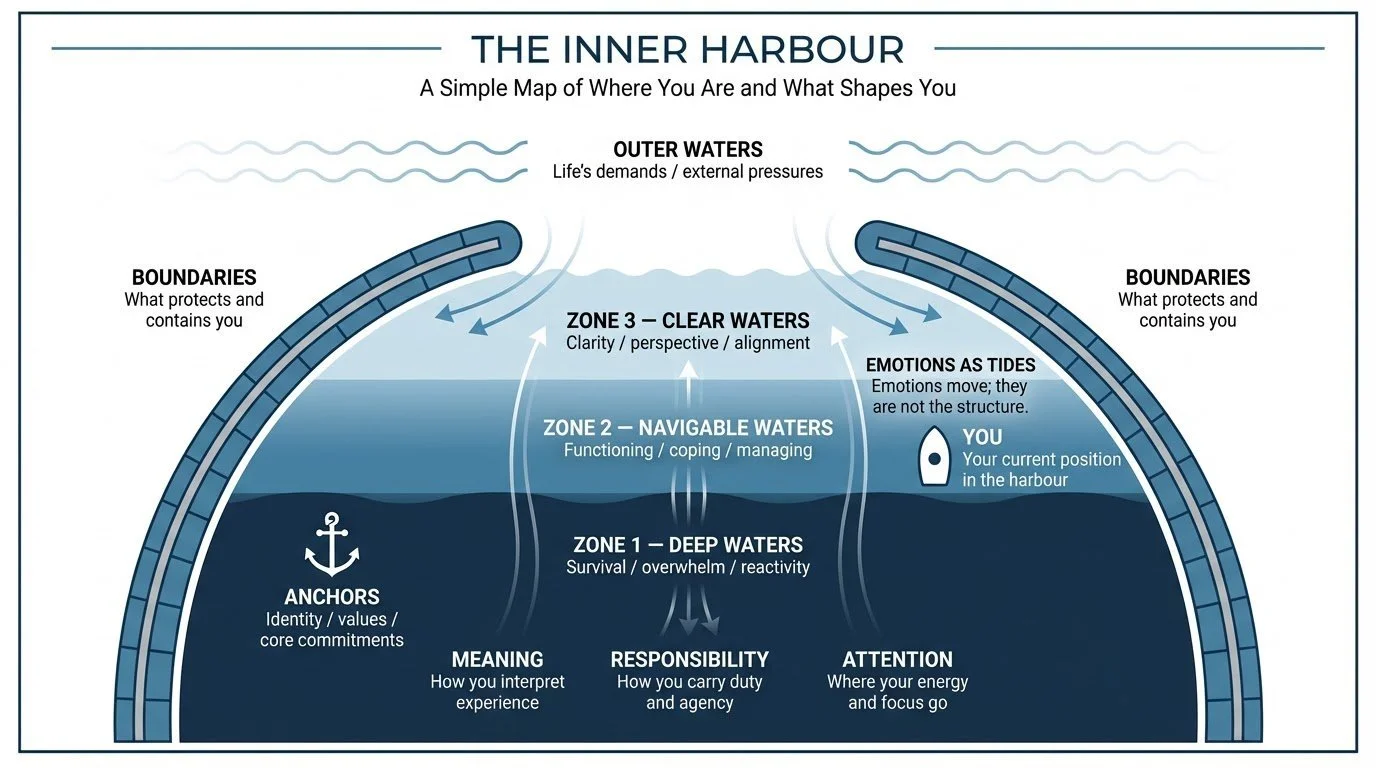
The Harbour represents the fluidity, containment, and safety of the self, specifically in relation to the outside world.
The Zones as Depths
The three zones are mapped as different conditions of water:
Zone 1 is "Deep Waters" (survival and overwhelm)
Zone 2 is "Navigable Waters" (where you are represented as a boat actively steering and functioning)
Zone 3 is "Clear Waters" (perspective and alignment)
The Base
Your identity, values, and core commitments act as heavy Anchors that keep you safely moored.
Emotions
Emotions are viewed as "Tides" - natural, fluid movements that shift your inner waters but are not the structure itself.
External Forces
Unlike the House, the Harbour map explicitly features "Boundaries" (curved breakwater walls) that protect and contain you from the "Outer Waters", which represent life's daily demands and external pressures. The House and the Harbour work together. The House describes your inner structure, how you rise from survival to clarity, from instinct to insight. The Harbour describes your emotional landscape (or, inner weather) and how you return to safety, belonging, and regulation. One gives you stability; the other gives you movement. Together, they form a complete map of your inner world.
A Poetic Bridge Back to the Inner World
Within the Harbour, you can imagine yourself as a vessel navigating the inner waters, sometimes steady, sometimes overwhelmed, sometimes clear and aligned. At the centre of this Harbour sits a larger, steadier vessel: the core self that holds your values, memories, and emotional truth. Smaller “boats”, different states, moods, or parts of you, return to this central vessel for rest and reconnection. This imagery helps you understand how your inner world organises itself, especially during emotional shifts.
This central vessel is the place you return to, the inner home that gathers you when the waters have been rough.
The Harbour is the place where your inner weather settles. The tides are your emotional rhythms. The breakwaters are the boundaries that keep you from being swept away. A “Mother Ship” is the part of you that can hold everything you’ve carried. None of this is literal, yet all of it is true. The metaphor lets you feel what regulation, safety, and return actually mean inside your body.
The Psychological Foundations Beneath the Harbour
The symbolic and the psychological are not opposites here, they are two ways of approaching the same inner landscape. One gives you language; the other gives you meaning. While the Harbour of Homecoming is expressed in symbolic, mythic language, it rests on well-established psychological principles. The metaphor gives shape to emotional processes that are often difficult to articulate literally, but the underlying dynamics are grounded in how humans regulate, relate, and return to themselves.
Several key frameworks map directly onto the Harbour:
Window of Tolerance - the range in which your nervous system can stay regulated, represented by the shift from Deep Waters to Navigable Waters to Clear Waters.
Attachment Patterns - the early relational templates that shape how safe you feel approaching or retreating from the Outer Waters.
Co-regulation and Self-regulation - the way emotional steadiness is built through both inner anchoring and supportive relationships, reflected in the Mother Ship and the smaller vessels.
Boundaries and Containment - the curved breakwaters that protect your inner waters from external overwhelm.
Parts Work / Internal Family Systems - the idea that you are not one self but many “boats,” each carrying different needs, emotions, and histories.
These concepts offer a practical foundation for what the Harbour expresses symbolically: how you lose your centre, how you find your way back, and how you stay anchored in who you are.