The Mighty Oak and the Acorn
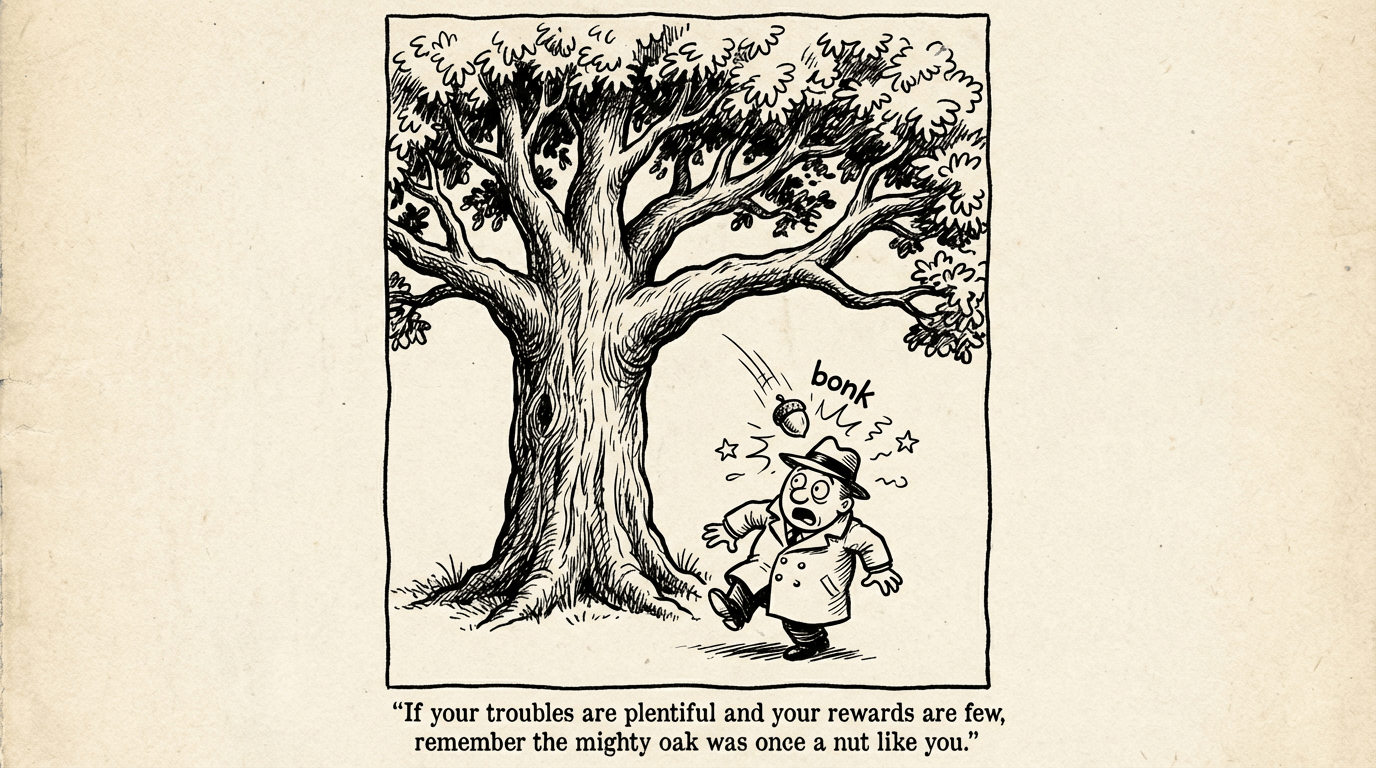
There was a wooden plaque in my grandparents’ house that I’ve never forgotten. It showed a towering oak tree, and a person being bopped on the head by a tiny acorn, looking rather foolish. Underneath was the line:
“If your troubles are plentiful and your rewards are few, remember the mighty oak was once a nut like you.”
Unhelpful Thinking Styles 101: Jumping to conclusions.
It’s a funny little rhyme, but it also captures one of the most common unhelpful thinking styles: Jumping to Conclusions. When we’re stressed, our minds rush to fill in the gaps. We assume we know what something means before we’ve taken the time to understand it. We predict outcomes based on fear rather than fact. We see the acorn and forget the oak.
In the cartoon above, the acorn falls and bumps the man on the head. He’s irritated, certain he already knows what’s worth paying attention to. But the joke is on him. The very things he dismisses as irrelevant are the ones that grow into giants above him. Stress does this to us. It narrows our vision. It makes us impatient. It pushes us toward conclusions that feel true but aren’t.
Jumping to conclusions often travels with two other thinking habits: Labelling and Mental Filtering. Labelling reduces a whole person, or ourselves, to a single word: “idiot”, “failure”, “nut”. Filtering makes us notice only the parts that confirm our fears. Together, they shrink the world down to whatever our stress tells us to see.
The oak reminds us that potential often hides in plain sight. Ideas, people, and even parts of ourselves need time to grow. When we slow down, stay curious, and resist the urge to leap to conclusions, we give ourselves the chance to see the whole picture, not just the acorn, but the oak it might become.
Curiosity is powerful, but it isn’t naïve. Terry Pratchett once wrote, “The trouble with having an open mind, of course, is that people will insist on coming along and trying to put things in it.” There’s truth in that. An open mind still needs boundaries. But a closed mind sees only the nut and never the tree.
Freedom lives where the mind stays open, open enough to learn, but steady enough to choose what to let in.
