Transformative, Evolutionary, Architecture (TEA)
See your flow, strengthen your currents, contribute to collective clarity.
The Inner Field
TEA shows how energy moves, circulates, and is conserved through presence, attention, and action. Most frameworks for self-understanding confuse identity with function, comfort with flow, or reflection with impact. TEA clarifies the current state of the inner field: what generates energy, what is drained or overcharged, and what must move to maintain integrity. Assessment is not about feeling inspired, it is about perceiving the invisible currents of meaning and responsibility, so you can act deliberately within your own energetics of being.
CTA - Take the 3-Minute Assessment
Secondary: "Learn the Framework"
FRAMEWORK OVERVIEW
Ten functions of energy in motion are mapped, not traits or moral qualities. The ten energetic streams are:
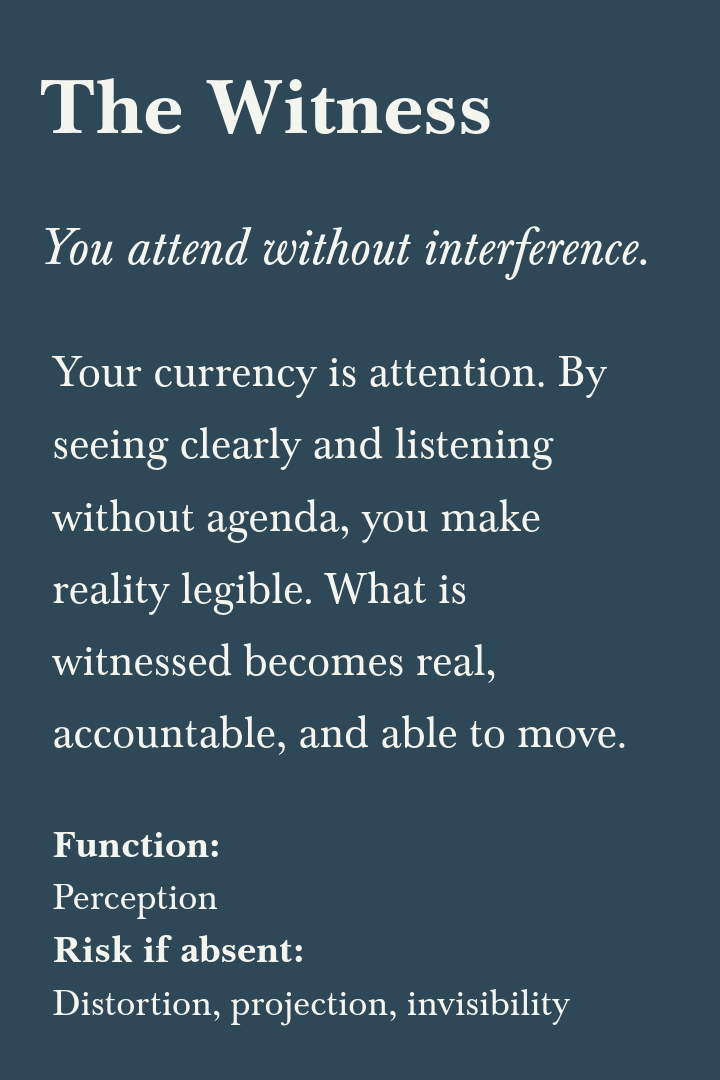
The Witness – attention
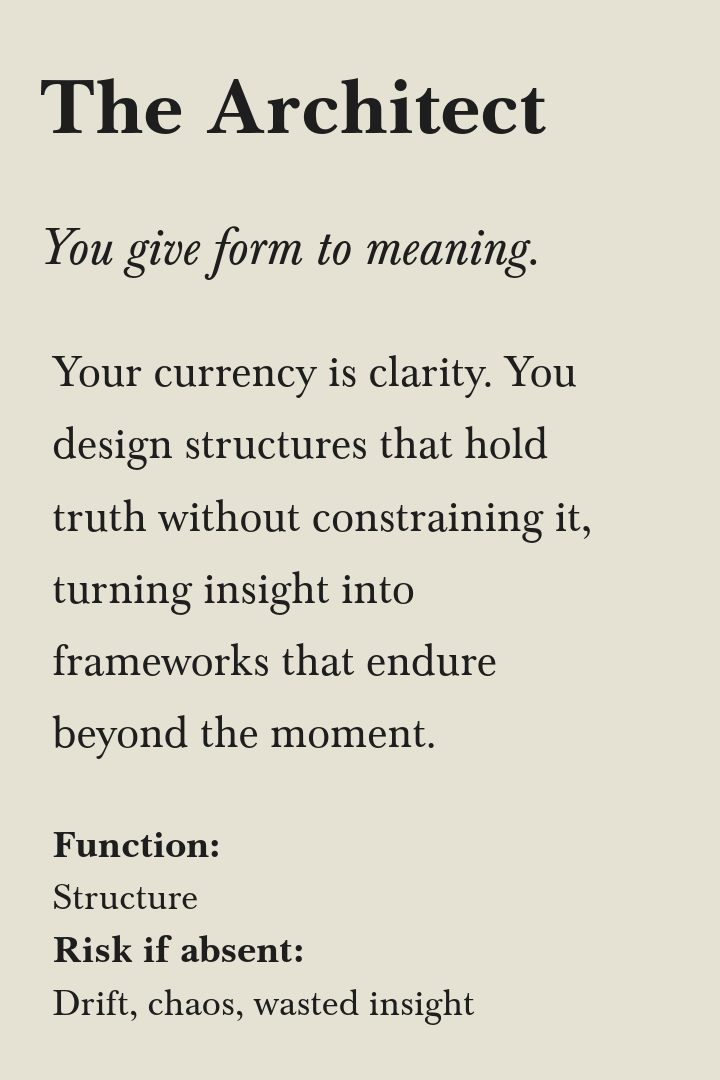
The Architect – clarity
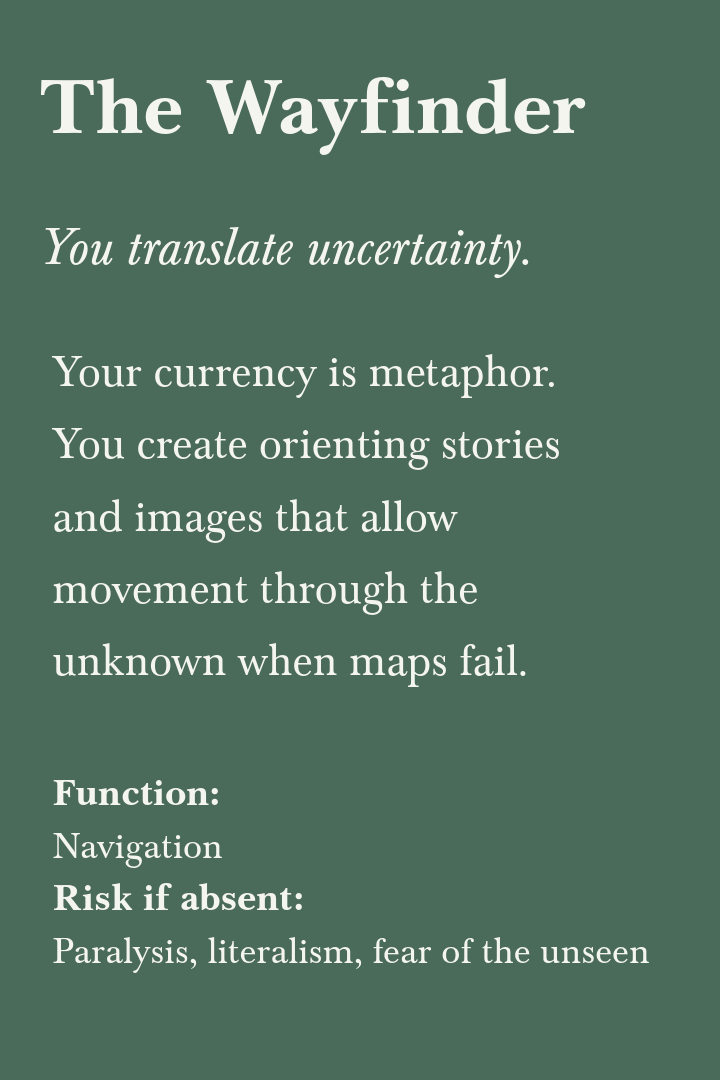
The Wayfinder – meaning-making
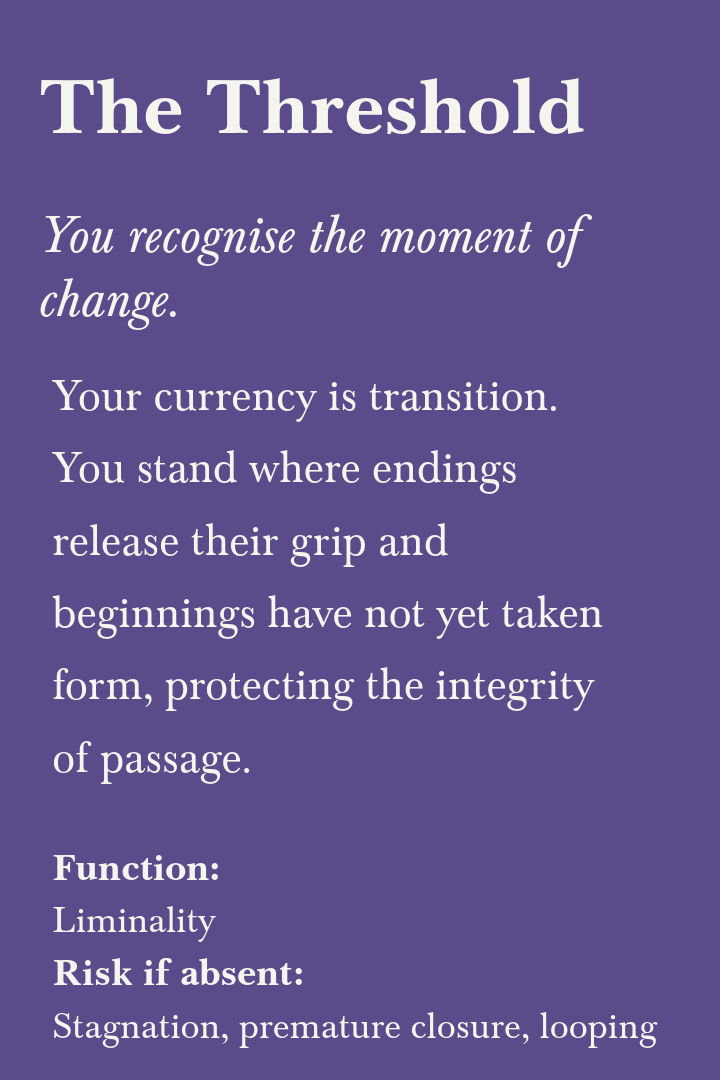
The Threshold – transition
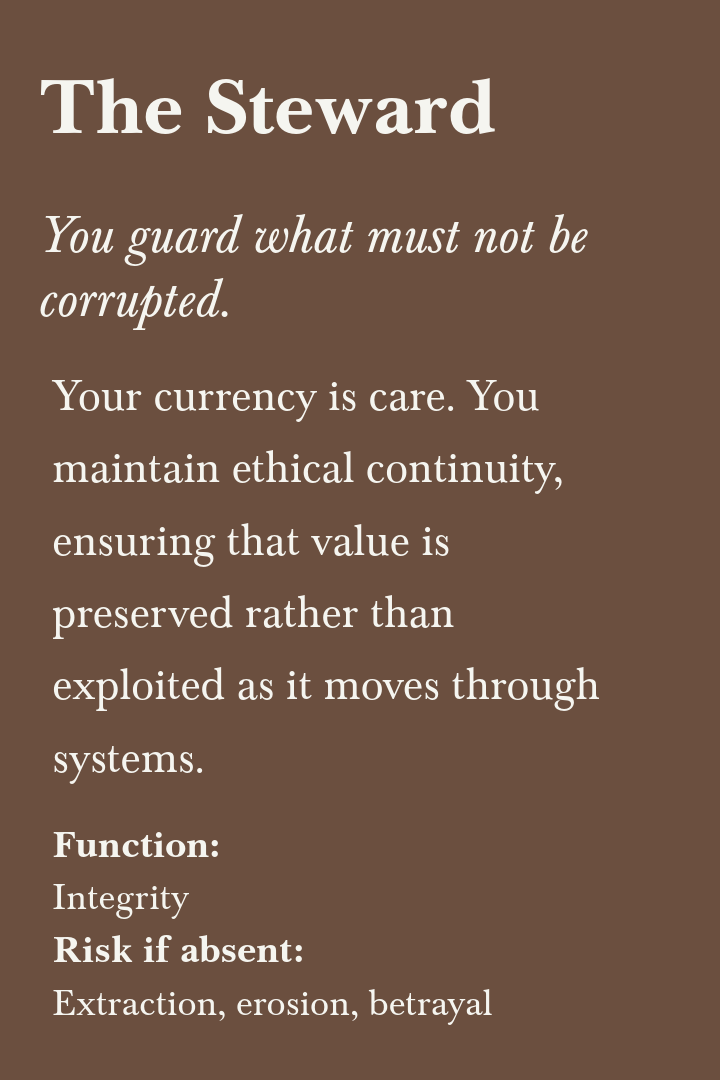
The Steward – integrity
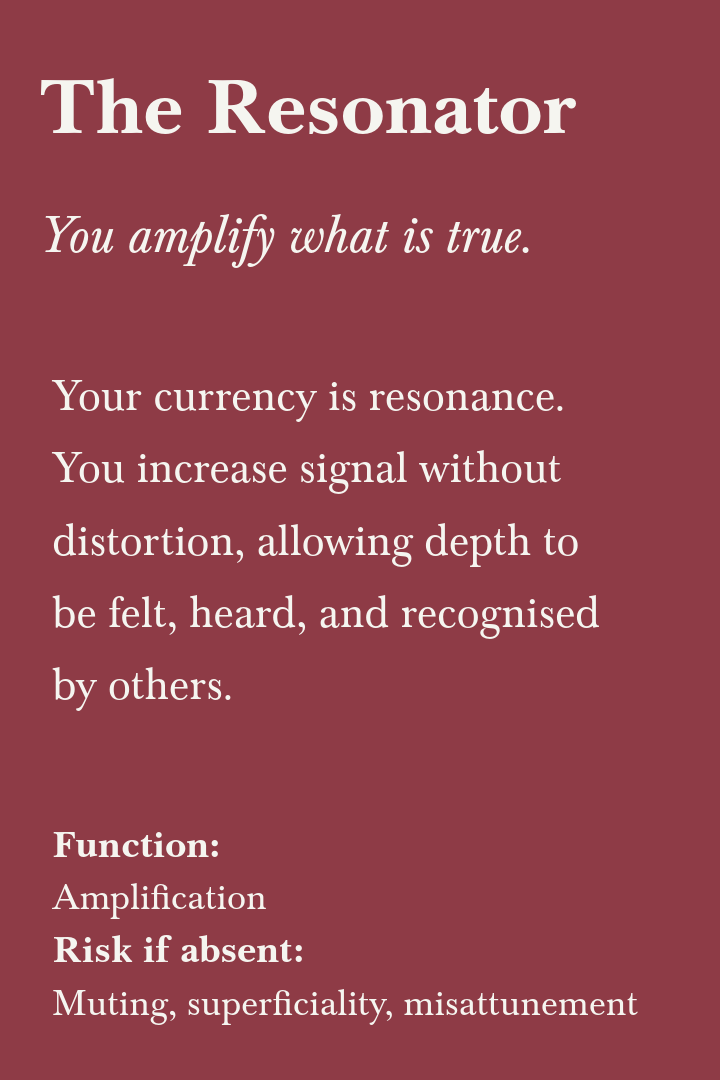
The Resonator – amplification of truth
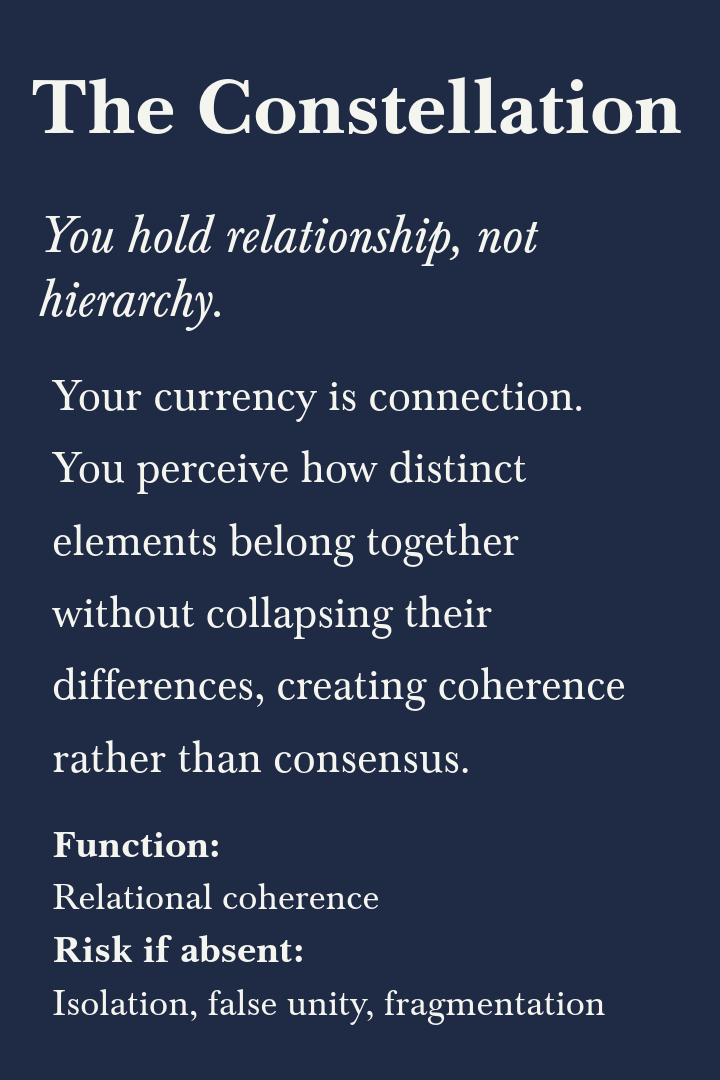
The Constellation – relational coherence
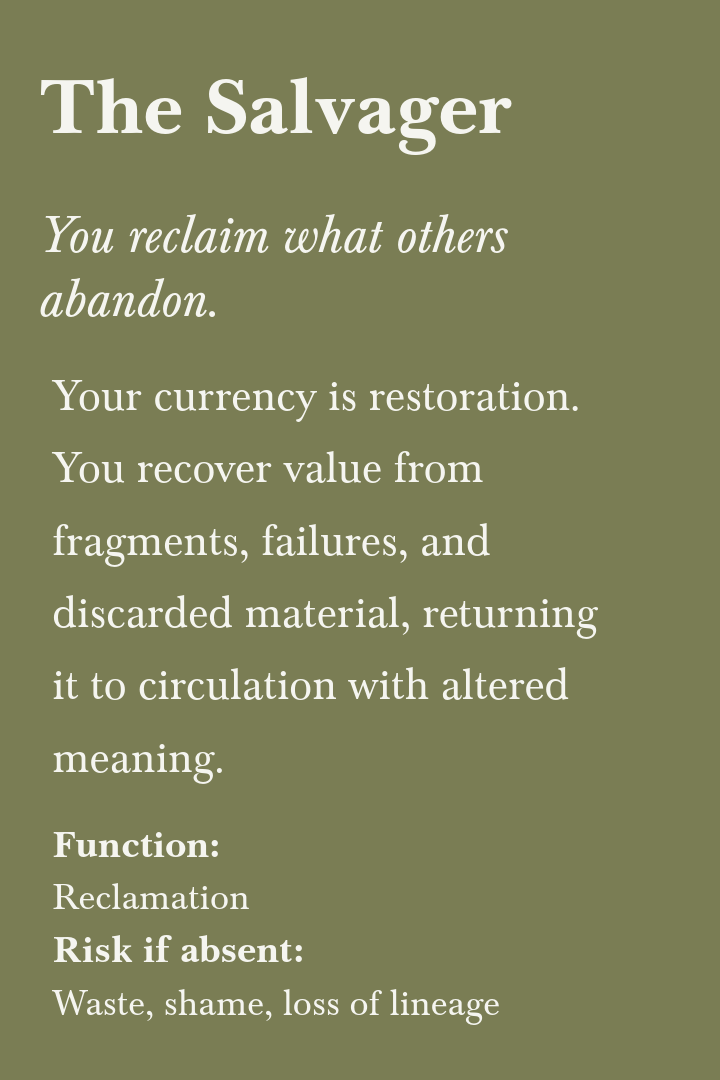
The Salvager – reclamation of lost value
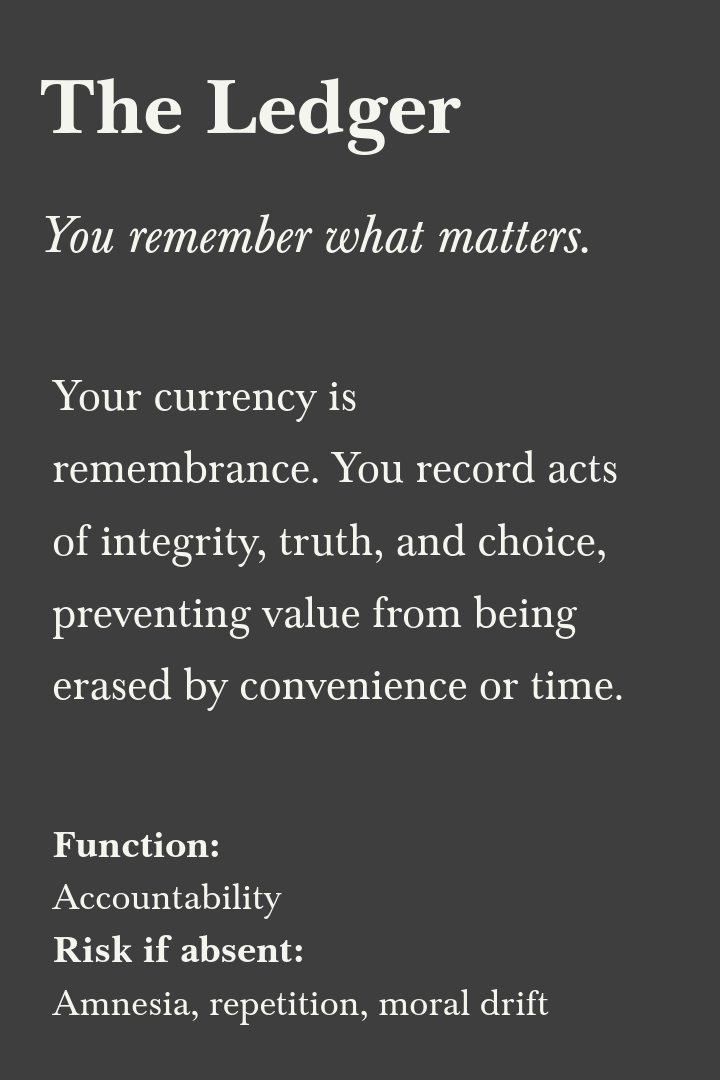
The Ledger – memory and accountability
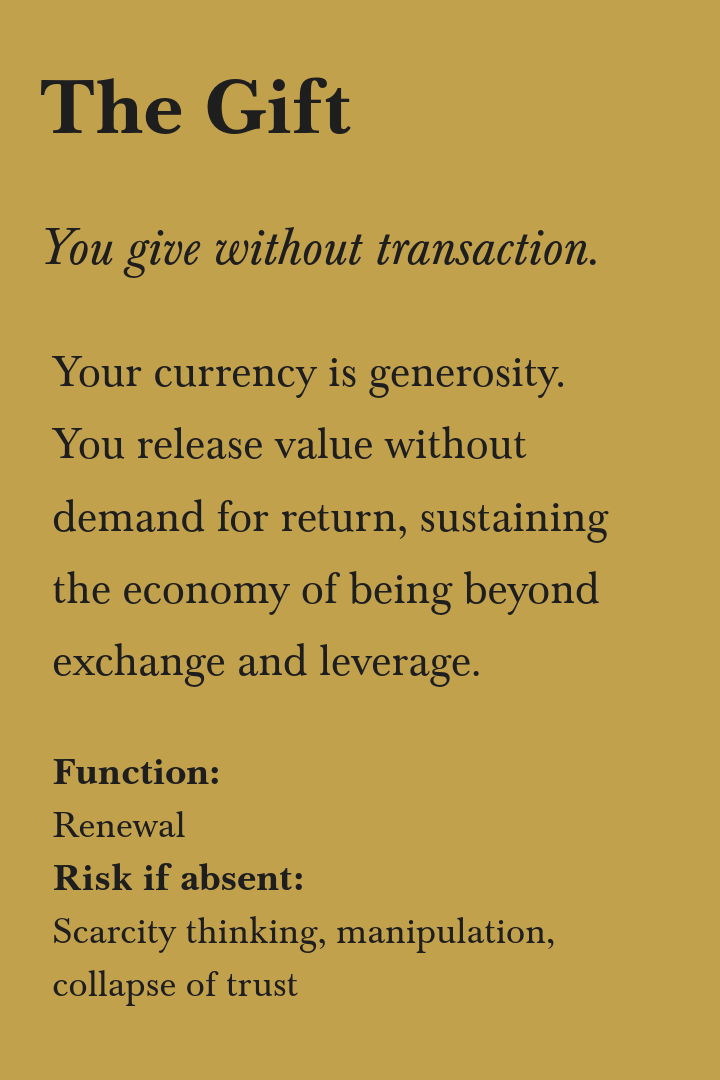
The Gift – non-transactional generosity
Each channel circulates meaning and energy by acting as a conduit through which attention, structure, care, and insight move between systems, relationships, and moments. Some generate energy directly (e.g., Witness, Architect), while others operate contextually to transform or integrate that energy (e.g., Salvager, Constellation).
By observing which forms of energy are active, depleted, or withheld, the cards allow you to diagnose patterns in how meaning and energy are flowing, revealing distortions, blockages, and opportunities for deliberate circulation.
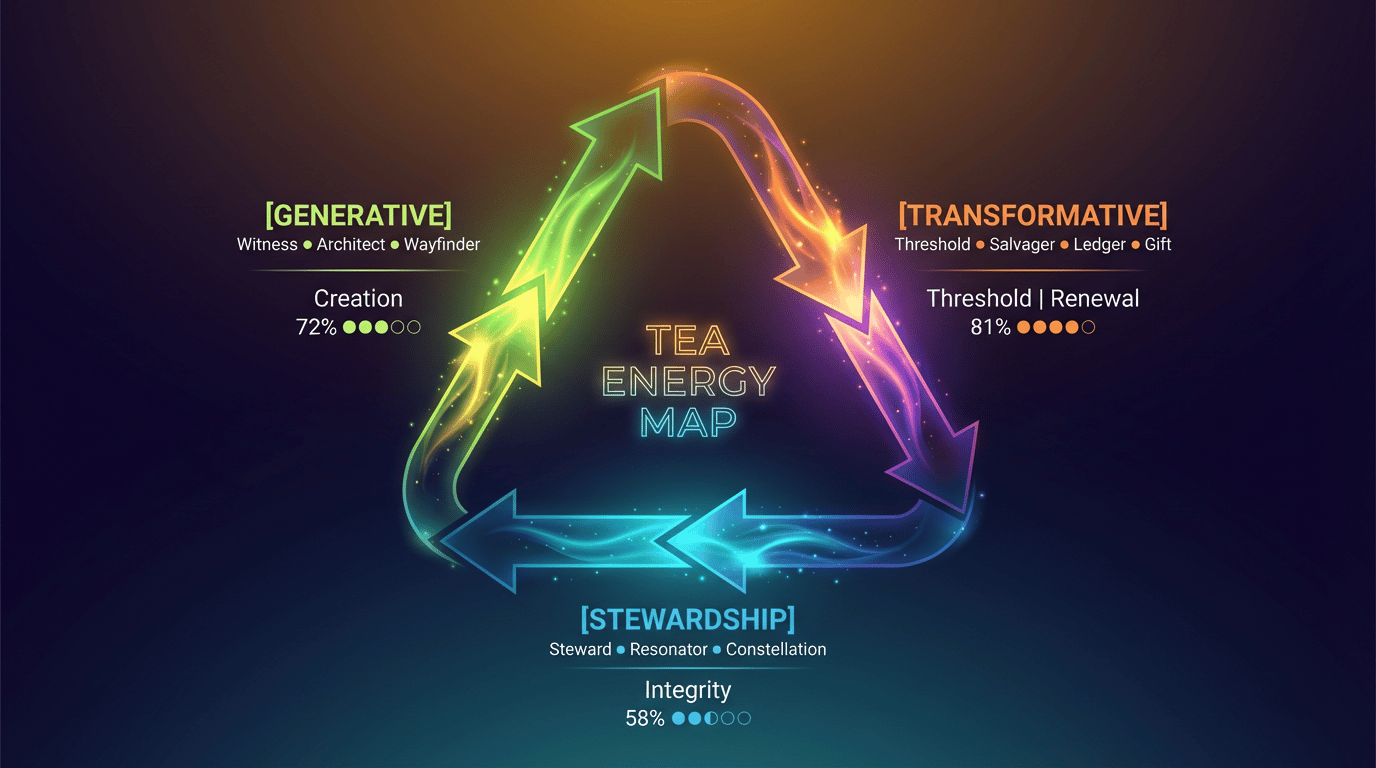
In short, the STREAMS, together with the MAIN CURRENTS, map the energetics of the Living Field: what you generate, where it moves, what is stored, and what is lost—so that insight becomes action rather than abstraction.
NEXT STEPS
## Join the Inner Field
[Email signup: "Get the TEA Primer + updates"
Follow on LinkedIn • Upcoming Workshops • Framework Guide
These energetic functions are not inherently positive. They can be:
Generated or depleted
Circulated or hoarded
Embodied or performed
Preserved or distorted
The assessment is designed to help you determine the quality of these invisible dynamics and decide whether or not you would like to make some changes to the way they are running in your life.
The assessment does not affirm or comfort. It does not promise balance, healing, or self-improvement. It offers language and structure for examining how you generate and direct energy, where it may be leaking, and what is being withheld, overlooked, or overused.
The power of the assessment lies not in interpretation, but in circulation: what you do with what is revealed.
These cards do not tell you who to be. They ask you to notice what you are already doing, and to decide, deliberately, what must move next.
Energetic Zones
The Living Framework maps how energy moves through three primary zones of your being: the generative, the stewardship, and the transformative. These zones are not personality types or fixed identities—they are states of energetic process that you move through constantly.
1. Generative Zone – Energy Generation & Orientation
The Generative Zone is where energy arises, is noticed, and begins to take form. Here, The Witness opens the channel of attention, The Architect brings structure to raw input, and The Wayfinder orients that energy toward meaning and direction. The Gift also touches this zone as the impulse to seed new energy into the world. This is where you sense, clarify, and choose the initial direction of your energetic investment.
2. Stewardship Zone – Energy Holding & Integrity
The Stewardship Zone is where energy is held, maintained, and kept coherent over time. The Steward guards boundaries and integrity, The Ledger stores memory and consequence, and The Constellation maintains relational coherence so energy does not fragment. In this zone, you decide what commitments are sustained, what is protected, and how your energetic promises are honoured.
3. Transformative Zone – Energy Repatterning & Release
The Transformative Zone is where energy changes state, shifts channels, or is released. The Threshold marks crossings between energetic states, The Salvager reclaims lost or misdirected energy, and The Resonator amplifies and transmits what has been clarified and integrated. The Gift appears here again as the non-transactional release of surplus energy back into the field. This zone reveals how you let go, reconfigure, or liberate energy so it can move differently.
Bridges Between Zones
Some cards, such as The Constellation and The Gift, act as bridges between zones. They help energy move from generation to stewardship, and from stewardship into transformation and release. The zones are not separate compartments but overlapping phases in the energetics of being—ways of noticing how you generate, hold, and repattern what moves through you.
How to Use the Value Mapping Cards
Prepare intentionally
Set aside time and minimize distraction. This is not casual. One card can shift perspective.Draw deliberately
Draw one card at a time, or select one that calls to you. Do not force comfort; choose what surfaces relevance or tension.Observe, don’t narrate
Notice what the card highlights: circulation, depletion, distortion, or integrity. Avoid self-flattering interpretations. Resist turning the card into advice or reassurance.Ask the key question
For each card:
“How is this currency moving through me right now? Where is it blocked, hoarded, or misused?”Record action, not feeling
Write down one concrete step you can take to move, release, or restore this currency. Focus on circulation, not reflection alone.Use in sequence or spread
The full deck can be laid out in spreads to identify imbalances. Keep attention on the structure and relationships between cards, not just individual meaning.Do not treat as therapy
These cards provide insight into patterns of value, not mental health care. Use alongside professional support when appropriate.Return and repeat
The deck is not a one-time tool. Values shift. Revisit regularly to detect new imbalances, distortions, or opportunities to circulate value.
Value Awareness Questionnaire
A short reflective tool designed to help you notice which forms of value you naturally generate, suppress, overextend, or leave uncirculated.
This is not a personality test, and it is not therapy. It is a structured aid to self-awareness designed to help you notice how you generate, circulate, and distort value through your way of being. It offers language and structure. This tool does not categorise you. It highlights tendencies in how value currently circulates, which can change with context and time.
The quiz invites you to observe patterns: what you give easily, what you withhold, what you perform because it is rewarded, and what may be running low. These are not traits or identities. They are currencies in motion, shaped by context, pressure, and choice.
You will be asked to make forced selections. This is intentional. Constraint reveals economy. If you try to choose the “best” answer, you will miss the point. Choose what is most true in practice, even if it is uncomfortable.
The results are not a verdict and they are not permanent. They are a snapshot of how value is currently circulating in your life and work. Use them as a mirror, not a label.
If you are seeking therapeutic support, crisis care, or help with acute distress, this is not the right place to begin. If you are willing to look honestly at how you operate, where you may be leaking or hoarding value, and what might need to move next, this tool will be useful.
Proceed slowly. Read carefully. Choose deliberately.
Scoring
Count how many times you chose A, B, C, and D.
The letter you chose most often indicates your dominant economy.
There are no balanced results.
RESULT A
Witness–Resonator Economy
Primary currencies: Attention and resonance
Dominant cards
The Witness
The Resonator
This person generates value by perceiving clearly and amplifying what is true. They make others feel real. Their presence sharpens signal.
Likely distortions
Attention becomes emotional labour
Resonance becomes performance
Being “available” replaces being honest
Cards they must confront
The Steward
To examine where care has become self-erasure.The Ledger
To name what has been repeatedly seen but never recorded or acted upon.
Diagnostic question
Where am I witnessing without taking responsibility for what I know?
RESULT B
Architect–Steward Economy
Primary currencies: Clarity and integrity
Dominant cards
The Architect
The Steward
This person generates value by building structures that hold people and systems together. They stabilise chaos and protect standards.
Likely distortions
Control masquerading as care
Over-responsibility
Structural rigidity that resists change
Cards they must confront:
The Threshold
To recognise when a structure has completed its purpose.The Gift
To release value without leverage or enforcement.
Diagnostic question: What am I holding together that should be allowed to change or end?
RESULT C
Wayfinder–Ledger Economy
Primary currencies: Meaning and remembrance
Dominant cards
The Wayfinder
The Ledger
This person generates value by translating experience into understanding and ensuring that meaning is not lost over time.
Likely distortions
Narrative dominance
Over-interpretation
Using insight to avoid action
Cards they must confront
The Architect
To convert meaning into form, not explanation.The Constellation
To allow multiple meanings to coexist without hierarchy.
Diagnostic question: Where am I explaining instead of structuring or acting?
RESULT D
Threshold–Gift Economy
Primary currencies: Transition and generosity
Dominant cards
The Threshold
The Gift
This person generates value by enabling endings, releases, and non-transactional exchange. They create movement where others cling.
Likely distortions
Detachment framed as freedom
Premature endings
Avoidance of accountability
Cards they must confront
The Ledger
To ensure what ends is properly marked and learned from.The Steward
To examine the impact of leaving on others and systems.
Diagnostic question: What am I letting go of without taking responsibility for its consequences?
Secondary deck alignment rules (important)
These apply regardless of dominant result.
If depletion was identified in the quiz
The Depleted Currency always maps to the card that must be restored through circulation, not reflection.
Example:
Depleted clarity → Architect must be acted, not admired.
If counterfeiting was identified
The Counterfeit Currency card should be removed from daily identification entirely for a period. It is overused and unreliable.
Example:
Counterfeit Witness → stop offering presence where truth is being withheld.
If a currency never appeared
That card is absent from the economy, not neutral.
Absence requires intentional invitation, not correction.
The Currency Balance Assessment
Purpose:
To expose where a person is over-invested, under-capitalised, or leaking value in their way of being.
Constraint:
The participant must choose. No card can sit in more than one position.
Step 1: Lay the ground
Shuffle the 10 cards. Place them face up. This is not intuitive. Visibility matters.
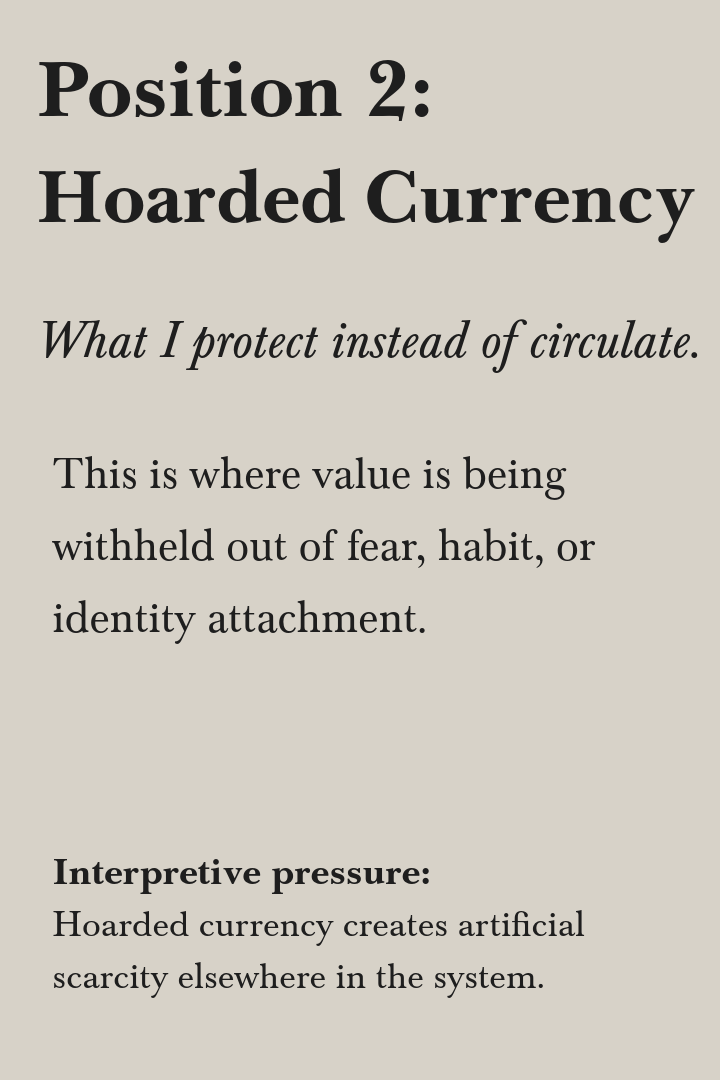
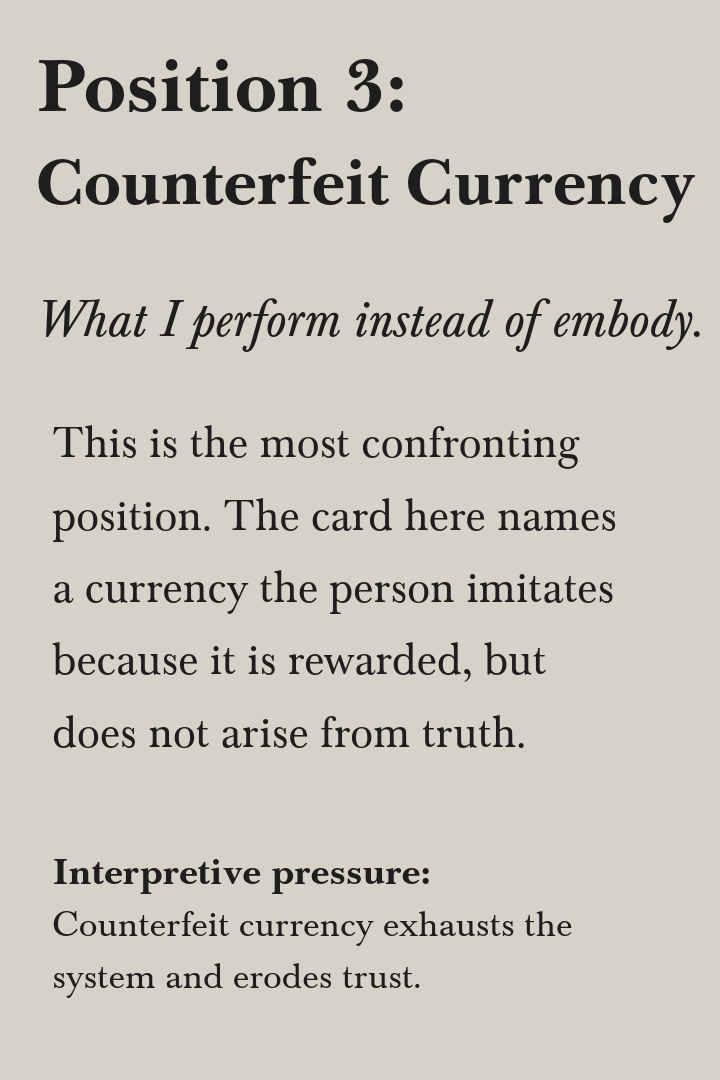
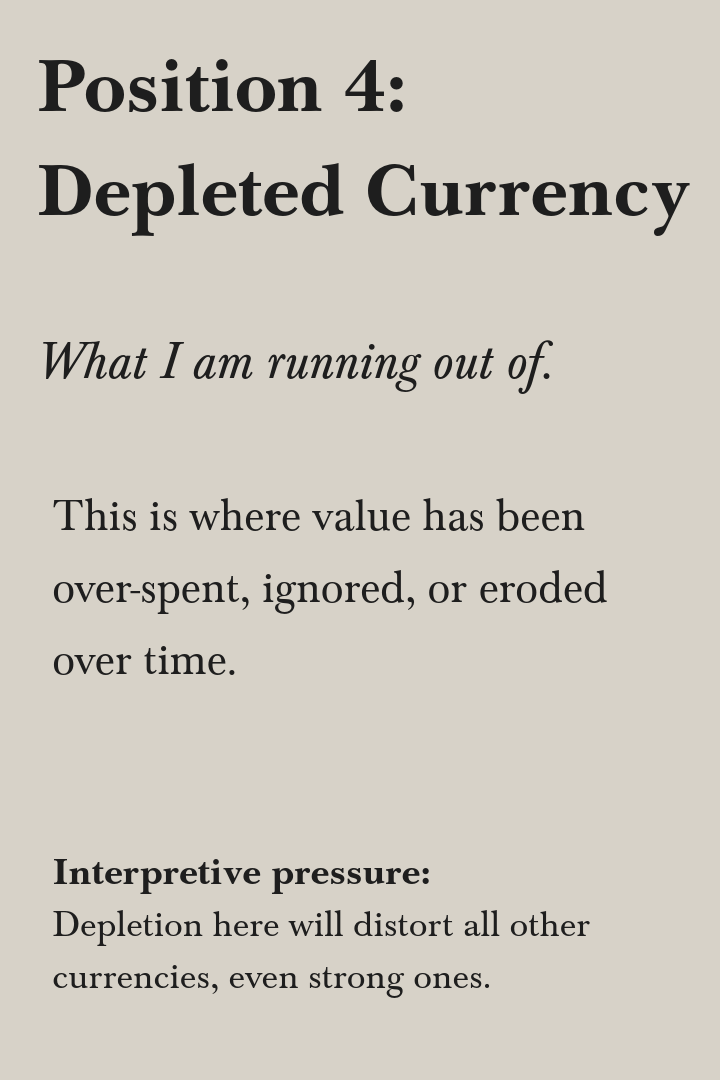
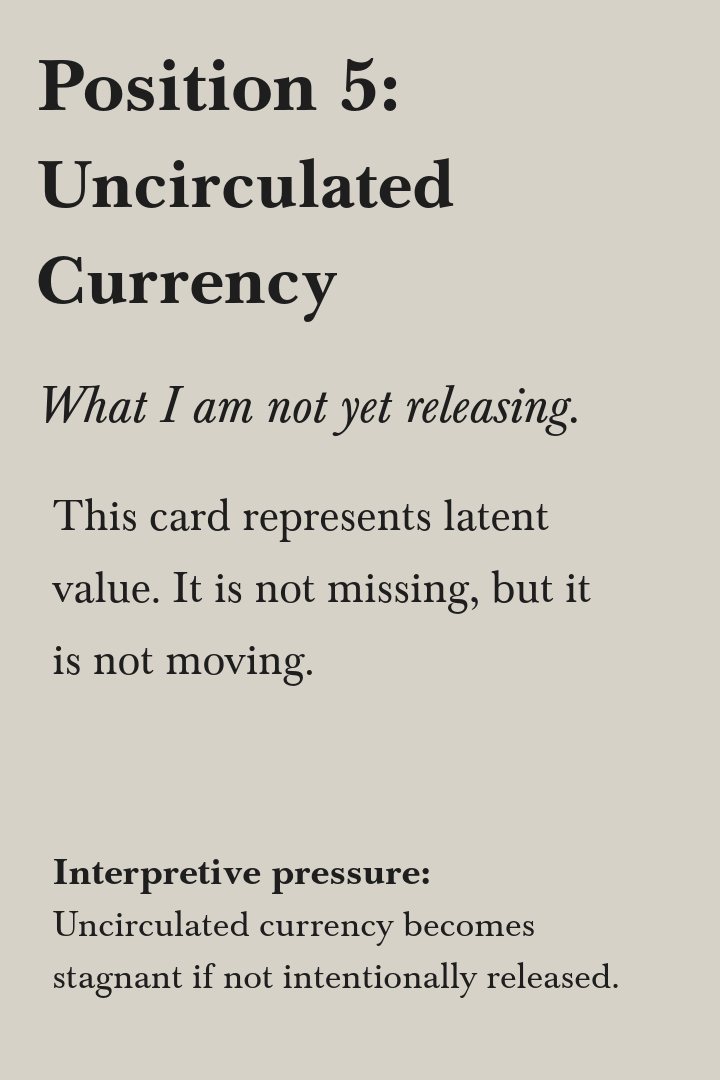
Step 2: The five positions
Arrange five positions in a straight horizontal line. This reads as a flow of value, not a personality map.
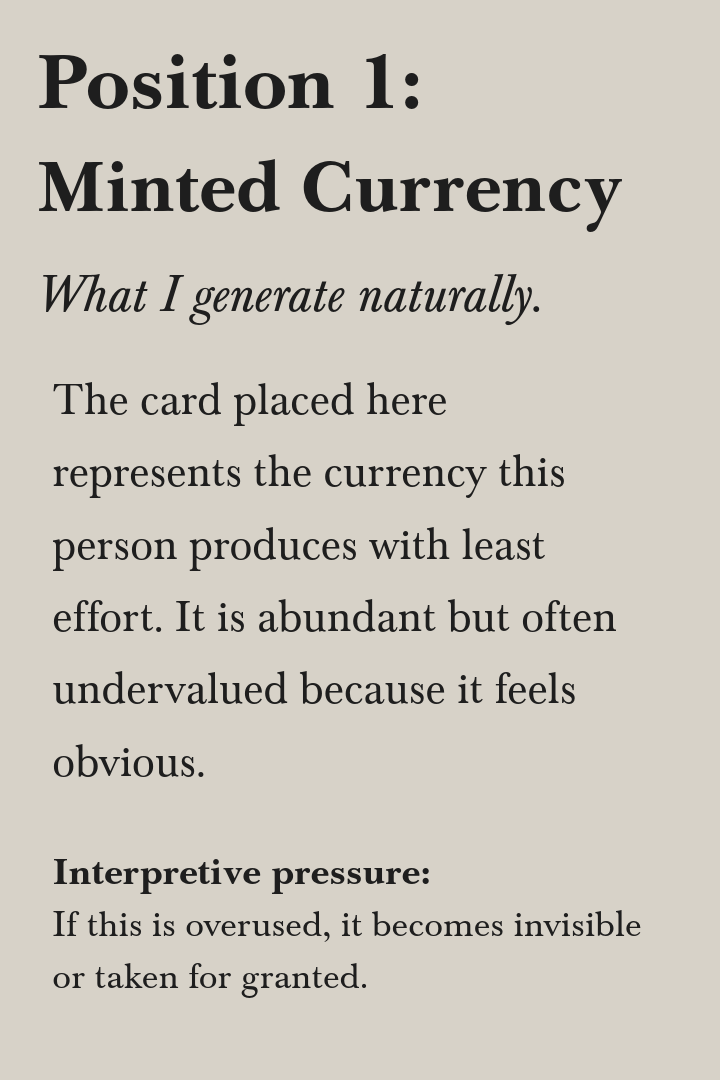
Position 1: Minted Currency
Position 2: Hoarded Currency
Position 3: Counterfeit Currency
Position 4: Depleted Currency
Position 5: Uncirculated Currency
Examples of Using the Currency of Being Cards
Case Study 1: Individual Insight – The Manager
Participant: “Alex,” a mid-level manager navigating a high-pressure project environment.
Context: Alex notices recurring tension in his team: some tasks stall, others are over-managed, and certain team members feel unseen. Alex wants clarity on his own role in the flow of value without seeking advice or validation.
Step 1: Drawing a card
Alex shuffles the deck and draws The Steward. He asks:
“Where am I protecting what should circulate, and what impact does that have?”
Insight: Alex realises he is micromanaging elements that team members could handle, hoarding responsibility rather than distributing it.
Step 2: Laying a spread
Alex lays out a five-card diagnostic spread designed to reveal imbalances:
Minted Currency: The Witness – shows Alex naturally gives attention.
Hoarded Currency: The Steward – shows over-protection of structure.
Counterfeit Currency: The Gift – Alex performs generosity to maintain status, not circulation.
Depleted Currency: The Ledger – Alex has neglected documenting decisions, leading to repeated confusion.
Uncirculated Currency: The Threshold – transition moments are ignored, causing stalled change.
Step 3: Reflection to action
Alex does not journal feelings. Instead, he identifies one concrete circulation step per key card:
Steward → delegate responsibility explicitly.
Ledger → implement a shared record of decisions.
Threshold → hold short check-ins to mark progress and transitions.
Outcome:
Within two weeks, Alex observes:
Decisions move faster; team members take ownership.
Miscommunication declines.
Alex’s natural ability to witness (attention) circulates more freely without overburdening him.
Lesson:
The cards do not tell Alex who to be or “fix” the team. They reveal how value moves, where it is blocked, and what action is required to restore circulation. The Currency of Being becomes a map, not a prescription.
Case Study 2: The Single Mother
Scenario:
Emma is a single mother balancing paid work, childcare, and household responsibility. She is highly capable but chronically exhausted. Time, energy, and attention feel scarce, and guilt accompanies any attempt to rest or ask for support.
Cards highlighted:
The Gift (counterfeit) – generosity is over-performed as obligation rather than freely chosen.
The Steward (hoarded) – control is retained to prevent systems from failing.
The Ledger (depleted) – her own needs and contributions are unrecorded and therefore undervalued.
The Uncirculated Position reveals The Witness – her capacity to offer attention to herself is present but unreleased.
Action:
Emma identifies one circulation shift: she records her daily contributions without justification, releases one responsibility to a trusted support, and practices deliberate self-attention without explaining or defending it.
Outcome:
Within weeks, exhaustion eases slightly, resentment decreases, and decision-making becomes clearer. The system stabilises not because demands reduce, but because value is no longer leaking through unacknowledged labour.
Lesson:
The cards do not reduce Emma’s load. They reveal where value is being quietly extracted without circulation, and where restoration must begin.
Case Study 3: Questioning Belonging and Control
Scenario:
Jordan is involved in a tight-knit spiritual and professional community that offers purpose, language, and belonging. Over time, Jordan notices discomfort: questioning is subtly discouraged, time and loyalty demands escalate, and leaving feels framed as failure or betrayal. Jordan is unsure whether this is healthy commitment or something more coercive.
Cards highlighted:
The Constellation (distorted) – connection exists, but individuality is subordinated to the group narrative.
The Ledger (withheld) – decisions, sacrifices, and costs are not fully named or recorded.
The Witness (restricted) – attention is permitted only toward approved interpretations.
The Threshold (blocked) – leaving or pausing is framed as danger rather than transition.
Action:
Using the cards, Jordan maps what is allowed to circulate and what is constrained. He documents unspoken rules, tracks emotional and practical costs, and identifies which questions are treated as threats rather than inquiry. No conclusions are forced. The focus is on circulation conditions, not labels.
Outcome:
Jordan gains clarity about how value, loyalty, and meaning are managed within the system. Whether he stays, renegotiates involvement, or leaves, his decision is grounded in observed patterns rather than fear or idealisation.
Lesson:
The cards do not determine whether a group is a cult. They reveal whether meaning and value circulate freely, conditionally, or coercively, allowing discernment without panic or denial.